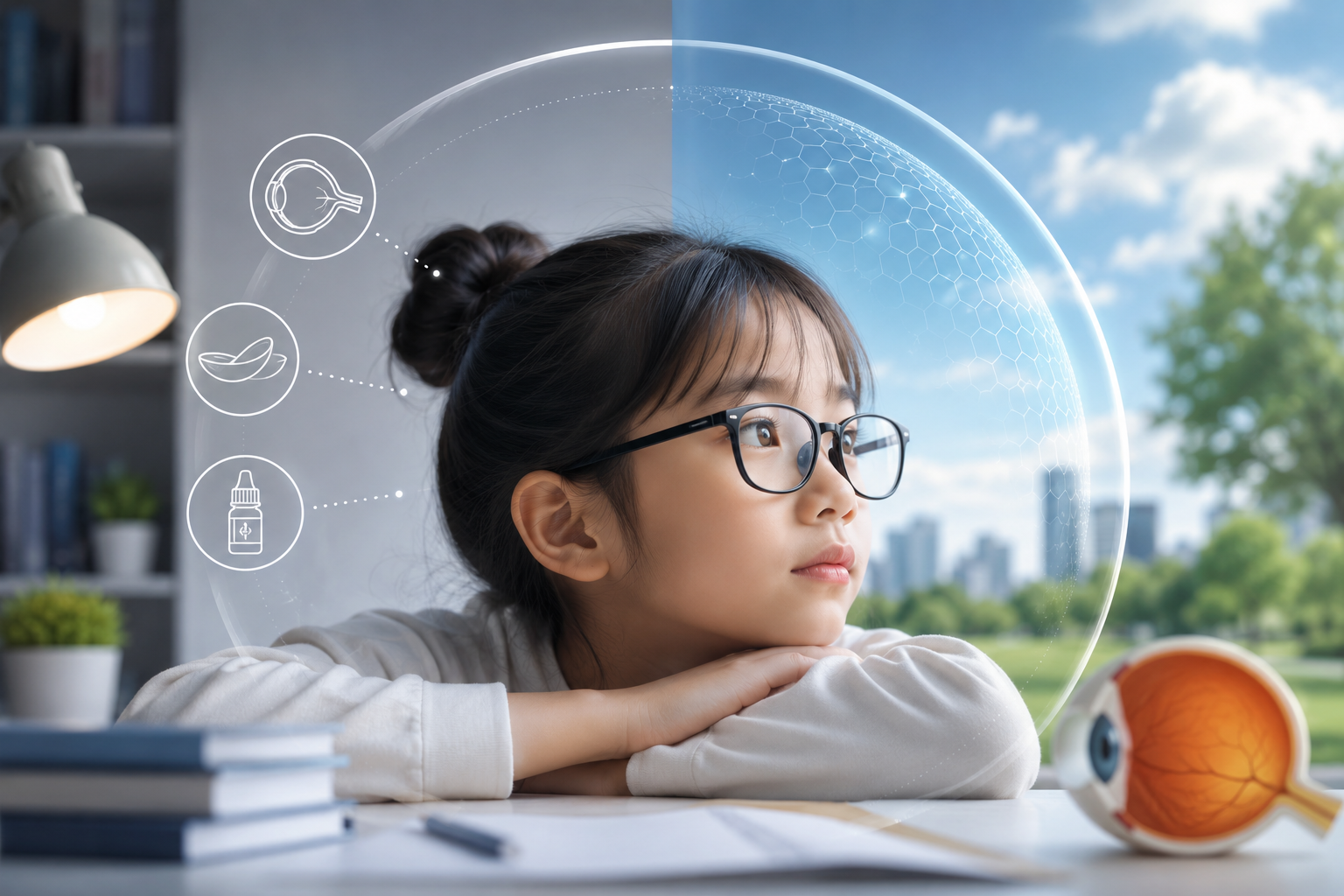
If your child’s glasses prescription becomes stronger each year, you may wonder whether anything can be done beyond updating the lenses. The answer is often: Yes!
Several evidence-based myopia control treatments for children can slow the rate at which nearsightedness progresses.
Myopia control does not cure myopia, reverse existing eye growth or guarantee that progression will stop. Its goal is to reduce further changes in prescription and eye length over time. Because children who develop myopia at a younger age often have more years in which it can progress, early assessment and regular monitoring are important.
What is myopia?
Myopia, also called nearsightedness, causes distant objects to appear.
Myopia control cannot eliminate these risks, and not every child blurry while nearer objects may remain clear. It usually occurs because the eye has grown too long from front to back. Light entering the eye then focuses in front of the retina instead of directly on it.
Standard glasses and contact lenses move the focus back onto the retina so a child can see clearly. However, standard single-vision correction does not slow the underlying elongation of the eye. Myopia control treatments (optical or pharmaceutical) are designed to reduce the rate of progression.
Why is childhood myopia becoming more common?
Myopia results from a combination of genetic and environmental factors. A child is more likely to develop myopia if one or both parents are near sighted. However, family history is not the only factor.
Less time outdoors and greater amounts of near work are associated with myopia. A 2025 systematic review also found an association between increasing digital screen time and higher odds of myopia. This does not prove that screens alone cause myopia since increased screen use may also represent prolonged near work, less outdoor time, or other shared factors.
The most useful approach is not to blame one device or activity. Instead, families can balance necessary schoolwork and screen use with outdoor time, regular breaks, and an appropriate working distance.
Why does slowing myopia progression matter?
Myopia is more than a blurry-distance-vision problem. As myopia and axial length increase, the lifetime risk of conditions such as myopic maculopathy, retinal detachment, glaucoma, and cataract also rises will respond equally. However, reducing a child’s final level of myopia is expected to reduce future risk compared with allowing the same eye to progress further. Treatment also helps preserve more manageable prescriptions for glasses and contact lenses.
Signs a child may be developing myopia
Children may not realize that their distance vision has changed. Possible signs include:
- Squinting to see the classroom board, television or distant signs
- Moving closer to the television or front of the classroom
- Holding books or devices unusually close
- Difficulty recognizing people or objects at a distance
- Complaints of blurry distance vision or visual fatigue
- Reduced performance in activities that depend on clear distance vision
Headaches and eye rubbing are not specific to myopia and can have many causes. A comprehensive eye examination is the best way to determine why a child is having visual symptoms.
How is childhood myopia assessed?
A comprehensive children’s eye examination evaluates visual acuity, refractive error, focusing and eye-teaming function, and ocular health. Cycloplegic eye drops may be used when clinically indicated to temporarily relax focusing and obtain a more accurate prescription.
For myopia management, the optometrist also reviews factors that can influence progression, including:
- The child’s age when myopia began
- The amount and rate of prescription change
- Family history of myopia
- Time spent outdoors and patterns of near work
- Current glasses or contact lens use
- Eye health, binocular vision and treatment suitability
When the equipment is available, axial length—the front-to-back length of the eye—may also be measured. Tracking refraction and, where appropriate, axial length helps the optometrist assess progression and response to treatment.
Can childhood myopia really be slowed?
Current evidence supports several optical and pharmaceutical interventions that can slow the progression of near sightedness and axial elongation in many children. The 2025 Cochrane living systematic review and the International Myopia Institute both recognize effective options such as specially designed spectacle lenses, soft contact lenses, orthokeratology, and atropine.
There is no single treatment that is best for every child. Response varies, and comparisons between treatments are complicated by differences in age, baseline prescription, study design, wearing time, and duration of follow-up. A treatment plan should be based on the child’s clinical findings, lifestyle, ability to use the treatment safely, and the family’s preferences.
Myopia control treatment options for children
Myopia control spectacle lenses
Specialized spectacle lenses use optical designs that provide clear central vision while creating treatment signals in other areas of the lens. Randomized trials of several modern designs have shown slower myopia progression and axial elongation than standard single-vision glasses.
These lenses may be a good option for children who prefer glasses or are not ready for contact lenses. They need to be fitted accurately and worn as directed. They are different from ordinary single-vision glasses, which correct blur but are not designed to control myopia progression.
Myopia control soft contact lenses
Certain multifocal or dual-focus soft contact lenses are designed to correct distance vision while also reducing signals associated with eye growth. Clinical trials have demonstrated meaningful slowing of myopia progression in many children.
Daily disposable lenses may simplify care, but safe use still requires maturity, clean hands, correct insertion and removal, and adherence to the prescribed wearing schedule. Contact lenses should never be exposed to tap water, and a painful, red or light-sensitive eye requires prompt assessment.
Orthokeratology (Ortho-K)
Orthokeratology uses specially designed rigid contact lenses worn overnight. The lenses temporarily reshape the cornea so that many children can see clearly during the day without glasses or daytime contact lenses. The optical changes produced by Ortho-K can also slow axial elongation.
Ortho-K does not permanently reshape the eye; the effect depends on continued wear. Because the lenses are worn while sleeping, careful cleaning, handling and follow-up are essential to reduce the risk of infection and confirm that the cornea remains healthy.
Low-dose atropine eye drops
Atropine eye drops can slow myopia progression, although treatment effect and side effects vary with concentration. Lower concentrations generally produce less pupil dilation and near blur than higher concentrations, but the most suitable dose depends on the individual child and clinical response.
Low-dose atropine for myopia control is an off-label use in Canada and may require preparation by a compounding pharmacy. Off-label use means the medication is being prescribed for a purpose or concentration not specifically listed in its Canadian product labelling; it does not mean the treatment lacks supporting evidence. Parents should receive information about expected benefits, possible side effects, follow-up and alternatives before treatment begins.
Atropine does not correct distance blur, so the child will usually still need glasses or contact lenses.
Healthy visual habits for children
Lifestyle habits support eye health, but they should not be presented as a substitute for evidence-based treatment when a child’s myopia is progressing.
Encourage regular outdoor time
Outdoor time has its strongest evidence for reducing the chance that myopia will begin. Its effect on slowing progression after a child is already myopic is less certain. Even so, regular outdoor activity has broad health benefits and remains a sensible part of a myopia-management plan.
A practical target is approximately two hours outdoors per day when possible, divided across school, play and family activities. Children should still use appropriate sun protection and never look directly at the sun.
Break up prolonged near work
Encourage short breaks during reading, homework and screen use. Looking into the distance every 20 minutes is a simple reminder, although the exact timing is less important than avoiding long, uninterrupted periods of close work.
Keep a comfortable working distance
Books and digital devices should not be held extremely close. Good lighting, age-appropriate text size and a comfortable posture can reduce visual strain. These habits are supportive; they are not proven replacements for myopia control lenses or medication.
When should myopia control begin?
Myopia management should be discussed when myopia is diagnosed, particularly when the child is young, the prescription is changing or other risk factors are present. There is no universal starting age or prescription threshold that applies to every child.
The decision considers the child’s age, rate of change, family history, prescription, axial length when available, eye health and ability to follow the treatment safely. Starting earlier may be valuable for a child at higher risk, but treatment still requires informed discussion and ongoing review.
How is progress monitored?
Myopia control is an ongoing process rather than a one-time fitting. Follow-up intervals depend on the treatment and the child’s clinical findings. Visits may assess:
- Vision and prescription
- Axial length, when available and clinically useful
- Contact lens fit or spectacle-lens position
- Corneal and ocular-surface health
- Side effects and treatment adherence
- Whether the rate of progression has changed
If progression remains faster than expected, the optometrist may review wearing time, fit, dose, lifestyle factors or whether a different or combined strategy should be considered. Treatment should not be changed or stopped without professional guidance because some approaches can have rebound or loss of effect after discontinuation.
Frequently asked questions about myopia control
Will ordinary glasses stop myopia from getting worse?
Standard single-vision glasses correct blurry vision but do not usually slow myopia progression. Specialized myopia control spectacle lenses use different optical designs and have evidence for reducing progression in children.
Is myopia control safe?
Evidence-based treatments have generally demonstrated acceptable safety when appropriately prescribed and monitored. Each option has different considerations. Contact lenses carry a small but important infection risk, atropine can cause light sensitivity or near blur, and specialized lenses require correct use and follow-up. Your optometrist should explain the benefits, limitations and risks of the recommended option.
Can myopia be reversed?
No current treatment permanently reverses the eye elongation associated with myopia. Ortho-K can temporarily reshape the cornea and provide clear daytime vision, but it does not remove the underlying myopia. The goal of myopia control is to slow additional progression.
How long does myopia control treatment continue?
Treatment often continues while the child remains at risk of progression, which may extend through the teenage years and sometimes longer. The duration is individualized. Regular measurements help determine whether treatment should continue, change or eventually be tapered or stopped.
Does a child still need glasses while using atropine?
Usually, yes. Atropine is intended to slow progression, not correct existing distance blur. The child will generally continue to wear glasses or contact lenses for clear vision.
Myopia control and children’s eye exams in Oakville
If your child has been diagnosed with myopia or their prescription is changing, a myopia control assessment can help determine whether treatment is appropriate.
At Invision Eye Clinic in Oakville, we provide comprehensive children’s eye examinations and individualized myopia-management plans. Depending on the child’s needs, options may include specialized spectacle lenses, myopia control contact lenses, orthokeratology or low-dose atropine, with regular monitoring to evaluate vision, eye health and progression.
Contact Invision Eye Clinic to book a children’s eye exam or myopia control consultation in Oakville.

At Invision Eye Clinic, we believe everyone deserves clear, comfortable vision. Our team of experienced optometrists is dedicated to providing personalized eye care using state-of-the-art technology and a patient-first approach.